

Solutions

Revitalizing the Hospital Board
SITUATION
Overseeing rural hospitals today comes with an unusual set of challenges and increasing accountability. Board members are tasked with guiding their facility’s financial health despite everchanging circumstances. The current healthcare environment, including dynamics posed by workforce shortages, cyberattacks and artificial intelligence, has placed unprecedented demand on healthcare organizations and the communities they serve. To be effective, a board must be aligned with the hospital’s needs and equipped with knowledge and the ability to create workable strategies and solutions.
SOLUTION
Community hospital board members are often community leaders who participate fully in making and supporting decisions that further the hospital’s mission, vision and values while ensuring that every patient receives safe, high-quality, compassionate care. Backed by a high-performing, effective board, hospitals are well positioned for success. There are several key areas of focus for improved board performance.
BOARD BOUND
Recruitment to fill open board positions takes a bit more sophistication than asking for board nominations from the community. Traditionally, hospital boards have been comprised of community and business leaders skilled in finance, investment, fundraising, marketing and other key areas. Ideally, boards are diverse in terms of race, ethnicity, age and gender.
FIVE STEPS TO PROACTIVE HOSPITAL BOARD RECRUITMENT
1. The Onboarding Process
A strong onboarding process ensures new members have all the information they need to make informed decisions. These adjustments can help make the onboarding process easier for new trustees:
- Ask a seasoned board member to mentor new trustees and answer questions
- Educate new board members about the organization’s finances
- Provide a password-protected digital library so new trustees can access resources
- Provide educational information on the hospital’s history, mission, vision, organizational structure and values
- Provide resources on governance best practices
- Survey new trustees after six months
2. Board Composition
Including outside board members can be a best practice for good governance while providing fresh perspective and valuable expertise not found within the hospital’s service area. Board culture can also produce more honest assessments and swifter action in response to today’s rapidly changing healthcare environment. Avoiding conflicts of interest can be particularly challenging for trustees serving on smaller, more rural hospital boards. Bringing in outside members can help boards avoid this common issue and help keep hospital leadership accountable.
3. The Board’s Roles & Responsibilities
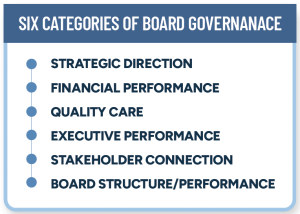
Too often, community hospital board members blur the lines between governance, management and operations. It’s important to keep the board focused on developing effective strategies and let hospital leadership handle the execution. Board responsibilities include providing guidance in these six key areas.
Posting clearly defined job roles and requirements when recruiting new community hospital board members can help eliminate organizational dysfunction. Clearly defined roles and responsibilities can also reduce board turnover while increasing membership diversity. Having job descriptions for board members, board chairs and/or committee chairs helps to guide actions that have the hospital’s best interest in mind.
Posting clearly defined job roles and requirements when recruiting new community hospital board members can help eliminate organizational dysfunction. Clearly defined roles and responsibilities can also reduce board turnover while increasing membership diversity. Having job descriptions for board members, board chairs and/or committee chairs helps to guide actions that have the hospital’s best interest in mind.
BOARD RESPONSIBILITY is deciding the right thing to do.
MANAGEMENT RESPONSIBILITY is deciding the right way to do the right thing.
4. Continuing Education Requirement
Many boards have no continuing education requirements. Yet ongoing education can provide a wealth of benefits that increases board effectiveness as well as engagement, including:
- New skills, knowledge and behavioral competencies critical for good governance
- Direction for making sound, responsible and wellinformed decisions
- Better understanding of current liability exposure, legal compliance issues and potential conflicts of interest
- Productive meetings in which issues for discussion and voting remain on the agenda, leaving informational items for reference only
5. Hospital Board Advisory Help
It’s no coincidence that well-performing boards often represent well-performing hospitals and health systems. A strong board and dependable, trustworthy leadership can make all the difference.
CHC Consulting offers Hospital Board Advisory services to help board members navigate changing regulations, challenging market conditions, and ultimately hospital performance. These services help to clarify the board’s authority over hospital financial health and welfare.